17th and 18th centuries
Ferdinand Verbiest, a member of a Jesuit mission in China, built the first steam-powered vehicle around 1672 as a toy for the Chinese Emperor. It was of small enough scale that it could not carry a driver but it was, quite possibly the first working steam-powered vehicle ('auto-mobile').
Cugnot's steam wagon, the second (1771) version
A replica of Richard Trevithick's 1801 road locomotive 'Puffing Devil'
 Steam-powered self-propelled vehicles large enough to transport people and cargo were first devised in the late 18th century. Nicolas-Joseph Cugnot demonstrated his fardier à vapeur ("steam dray"), an experimental steam-driven artillery tractor, in 1770 and 1771. As Cugnot's design proved to be impractical, his invention was not developed in his native France. The center of innovation shifted to Great Britain. By 1784, William Murdoch had built a working model of a steam carriage inRedruth. The first automobile patent in the United States was granted to Oliver Evans in 1789, and in 1801 Richard Trevithick was running a full-sized vehicle on the roads in Camborne.
19th century
Many vehicles were in vogue for a time, and over the next decades such innovations as hand brakes, multi-speedtransmissions, and better steering developed. Some were commercially successful in providing mass transit, until a backlash against these large speedy vehicles resulted in the passage of the Locomotive Act (1865), which required many self-propelled vehicles on public roads in the United Kingdom to be preceded by a man on foot waving a red flag and blowing a horn. This effectively halted road auto development in the UK for most of the rest of the 19th century; inventors and engineers shifted their efforts to improvements in railway locomotives. The law was not repealed until 1896, although the need for the red flag was removed in 1878.
Among other efforts, in 1815, a professor at Prague Polytechnic, Josef Bozek, built an oil-fired steam car. Walter Hancock, builder and operator of London steam buses, in 1838 built a four-seat steam phaeton.
In 1867, Canadian jeweller Henry Seth Taylor demonstrated his 4-wheeled "steam buggy" at the Stanstead Fair in Stanstead, Quebec, and again the following year. The basis of the buggy, which he began building in 1865, was a high-wheeled carriage with bracing to support a two-cylinder steam engine mounted on the floor.
What some people define as the first "real" automobile was produced by French Amédée Bollée in 1873, who built self-propelled steam road vehicles to transport groups of passengers.
The American George B. Selden filed for a patent on May 8, 1879. His application included not only the engine but its use in a 4-wheeled car. Selden filed a series of amendments to his application which stretched out the legal process, resulting in a delay of 16 years before the US 549160 was granted on November 5, 1895.
Karl Benz, the inventor of numerous car-related technologies, received a German patent in 1886.
 The four-stroke petrol (gasoline) internal combustion engine that constitutes the most prevalent form of modern automotive propulsion is a creation of Nikolaus Otto. The similar four-stroke diesel engine was invented by Rudolf Diesel. The hydrogen fuel cell, one of the technologies hailed as a replacement for gasoline as an energy source for cars, was discovered in principle by Christian Friedrich Schönbein in 1838. The battery electric car owes its beginnings to Ányos Jedlik, one of the inventors of the electric motor, and Gaston Planté, who invented the lead-acid battery in 1859. The first carriage-sized automobile suitable for use on existing wagon roads in the United States was a steam-powered vehicle invented in 1871, by Dr. J.W. Carhart, a minister of the Methodist Episcopal Church, in Racine, Wisconsin It induced the State of Wisconsin in 1875, to offer a $10,000 award to the first to produce a practical substitute for the use of horses and other animals. They stipulated that the vehicle would have to maintain an average speed of more than five miles per hour over a 200-mile course. The offer led to the first city to city automobile race in the United States, starting on July 16, 1878, in Green Bay, Wisconsin, and ending in Madison, via Appleton, Oshkosh, Waupun, Watertown, Fort Atkinson, and Janesville. While seven vehicles were registered, only two started to compete: the entries from Green Bay and Oshkosh. The vehicle from Green Bay was faster, but broke down before completing the race. The Oshkosh finished the 201 mile course in 33 hours and 27 minutes, and posted an average speed of six miles per hour. In 1879, the legislature awarded half the prize.
20th century
Pre WWII
Steam-powered road vehicles, both cars and wagons, reached the peak of their development in the early 1930s with fast-steaming lightweight boilers and efficient engine designs. Internal combustion engines also developed greatly during WWI, becoming simpler to operate and more reliable. The development of the high-speed diesel engine from 1930 began to replace them for wagons, accelerated by tax changes in the UK making steam wagons uneconomic overnight. Although a few designers continued to advocate steam power, no significant developments in production steam cars took place after Doble in 1931.
Post-WWII
Whether steam cars will ever be reborn in later technological eras remains to be seen. Magazines such as Light Steam Power continued to describe them into the 1980s. The 1950s saw interest in steam-turbine cars powered by small nuclear reactors (this was also true of aircraft), but the dangers inherent in nuclear fission technology soon killed these ideas.
Electric automobiles
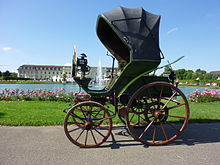
German Flocken Elektrowagen of 1888, regarded as the first electric car of the world
See also: History of the electric vehicle
In 1828, Ányos Jedlik, a Hungarian who invented an early type of electric motor, created a tiny model car powered by his new motor. In 1834, Vermont blacksmith Thomas Davenport, the inventor of the first American DC electrical motor, installed his motor in a small model car, which he operated on a short circular electrified track. In 1835, Professor Sibrandus Stratingh of Groningen, the Netherlands and his assistant Christopher Becker created a small-scale electrical car, powered by non-rechargeable primary cells. In 1838, Scotsman Robert Davidson built an electric locomotive that attained a speed of 4 miles per hour (6 km/h). In England, a patent was granted in 1840 for the use of rail tracks as conductors ofelectric current, and similar American patents were issued to Lilley and Colten in 1847. Between 1832 and 1839 (the exact year is uncertain) Robert Anderson of Scotland invented the first crude electric carriage, powered by non-rechargeableprimary cells.
The Flocken Elektrowagen of 1888 by German inventor Andreas Flocken is regarded as the first real electric car of the world.
Electric cars enjoyed popularity between the late 19th century and early 20th century, when electricity was among the preferred methods for automobile propulsion, providing a level of comfort and ease of operation that could not be achieved by the gasoline cars of the time. Advances in internal combustion technology, especially the electric starter, soon rendered this advantage moot; the greater range of gasoline cars, quicker refueling times, and growing petroleum infrastructure, along with the mass production of gasoline vehicles by companies such as the Ford Motor Company, which reduced prices of gasoline cars to less than half that of equivalent electric cars, led to a decline in the use of electric propulsion, effectively removing it from important markets such as the United States by the 1930s. However, in recent years, increased concerns over the environmental impact of gasoline cars, higher gasoline prices, improvements in battery technology, and the prospect of peak oil, have brought about renewed interest in electric cars, which are perceived to be more environmentally friendly and cheaper to maintain and run, despite high initial costs, after a failed reappearance in the late-1990s.
References:
Setright, L. J. K. (2004). Drive On!: A Social History of the Motor Car. Granta Books. ISBN 9781862076983.
A History of Wisconsin Highway Development 1835–1945, State Highway Commission of Wisconsin and the Public Roads Administration, Federal Works Agency, 1947, pp. 19–20
"America on the Move; Autocar automobile". Smithsonian Institution – National Museum of American History. Retrieved 2 January 2016.

Nincsenek megjegyzések:
Megjegyzés küldése